Should You Use AI to Write Your Resume? (Honest Take)
AI resume tools can help — or torpedo your job search. Here's how to use AI without fabricating experience, plus what hiring managers actually catch.
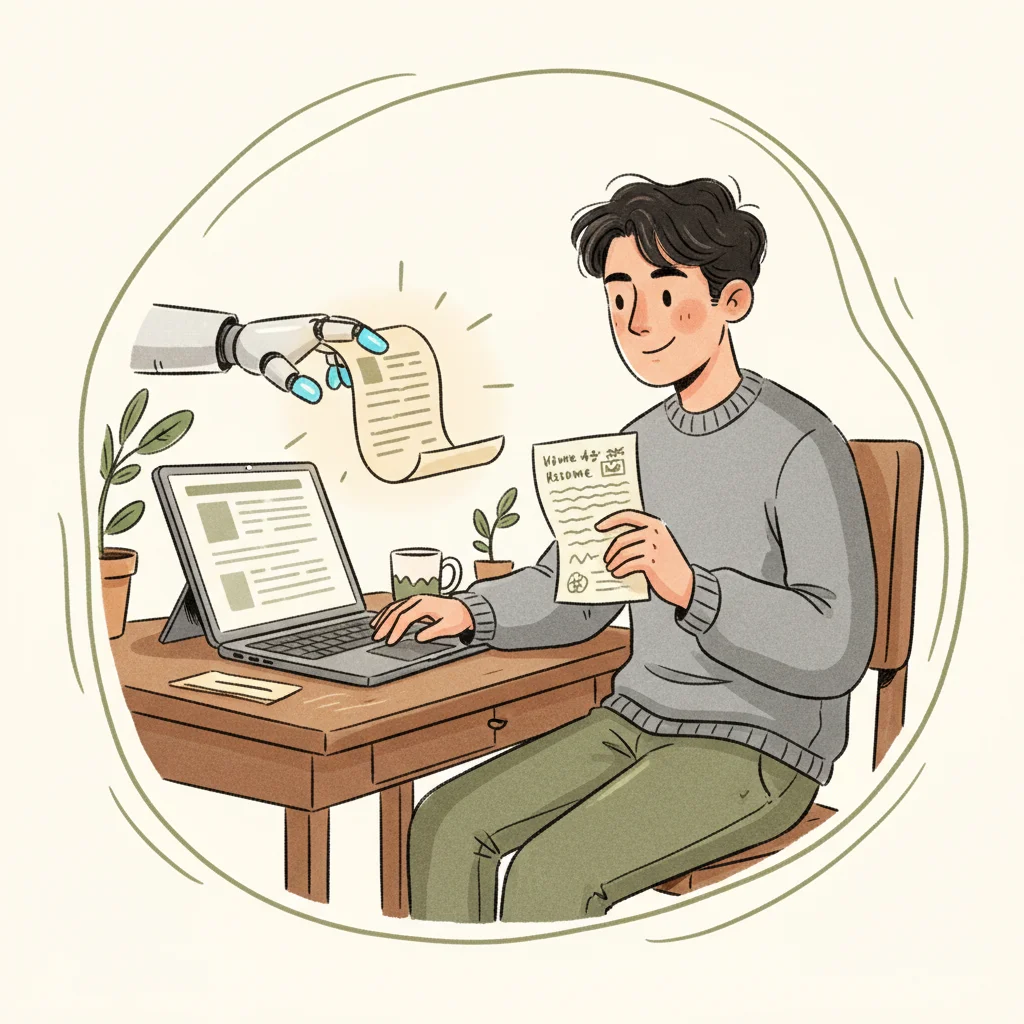
Yes, you should use AI on your resume — but most AI tools will fabricate your experience while "improving" it, and that fabrication will destroy you in interviews.
Hiring managers have gotten good at spotting AI-written resumes. Not because of robotic phrasing — because of the stuff that doesn't add up. Skills that don't match your career stage. Suspiciously precise metrics. Job responsibilities that no one at your level would have owned. When a candidate's resume promises things their interview can't deliver, the AI didn't help them. It sabotaged them.
The right way to use AI is for packaging, not invention. Sharpen weak bullet points. Align your language with a job description. Catch gaps you'd miss after staring at the same document for three hours. The wrong way is to let it generate experiences you never had — because that's what most tools do by default.
The Real Problem With AI Resume Tools
AI resume tools have a fundamental incentive problem: they're optimized to make your resume sound impressive, not accurate. You paste your resume, maybe a job description, and the tool rewrites everything to sound better. But "better" to the algorithm means "more impressive-sounding" — and that's where things go wrong.
Try this yourself. Open ChatGPT and paste a mediocre bullet point like:
Managed social media accounts for the company
The AI will almost certainly return something like:
Spearheaded a comprehensive social media strategy across 5 platforms, increasing follower engagement by 47% and driving $150K in attributed revenue within 6 months
That sounds impressive. It's also probably fiction. You didn't measure attributed revenue. The 47% is invented. And "spearheaded a comprehensive strategy" is a dramatic upgrade from "managed some accounts."
Here's what happens next: you use that bullet point. You get an interview. The hiring manager asks, "Tell me about the $150K in attributed revenue from social media." And you freeze, because it never happened.
This isn't a hypothetical. Career coaches and recruiters report seeing this pattern constantly — candidates with AI-polished resumes who can't back up their own bullet points in interviews. The resume got them in the door. The fabricated details got them rejected.
What AI Actually Does Well for Resumes
AI excels at three specific tasks when it's not fabricating:
Language matching. This is the biggest win. Job descriptions use specific terminology, and if your resume uses different words for the same skills, ATS software will score you lower. AI can identify the right keywords from a job posting and weave them into your existing experience — without changing what you actually did.
For example, if a job description says "cross-functional collaboration" and your resume says "worked with other teams," AI can rephrase that to "collaborated cross-functionally with engineering and design teams." Same truth, better keyword alignment.
Bullet point structure. Most people write resume bullets as job descriptions ("Responsible for managing client accounts") instead of accomplishments ("Managed 15 client accounts totaling $2M in annual revenue"). AI is good at restructuring your real experiences into accomplishment-oriented language. The key is that the underlying facts stay yours.
Catching what you missed. When you stare at your own resume for hours, you develop blind spots. AI can flag that you listed Python in your skills but never mentioned it in your experience section. Or that your most impressive project is buried in bullet five when it should be bullet one.
None of these require the AI to make anything up. They're all about better packaging of what's already true.
The Fabrication Spectrum
AI resume changes range from completely safe to career-ending, and most tools don't tell you which kind they're making. Here's how to categorize what you're seeing:
Safe: Rephrasing your real experience. Taking "helped customers" and turning it into "resolved customer inquiries" is a language upgrade, not fabrication. The fact is the same. The packaging improved.
Mostly safe: Quantifying with honest estimates. If you managed a team but never stated the size, adding "managed a team of 8" (when it was actually 8) is fine. AI can prompt you to add numbers you forgot. Just make sure every number is one you can defend.
Risky: Inflating scope or impact. Turning "contributed to a project" into "led the initiative" changes what you did. Some AI tools do this automatically because bigger-sounding achievements get higher scores in their internal ranking systems.
Dangerous: Inventing skills or experiences. Adding technologies you've never used, certifications you don't hold, or results you didn't achieve. This is where most AI resume builders cross the line, and it's where interviews fall apart.
The problem is that most AI tools operate across this entire spectrum simultaneously, and they don't flag which changes are rephrasing versus invention. You get back a polished document and have to figure out yourself which parts are still true.
How Hiring Managers Actually Catch AI Resumes
Forget AI detection software — hiring managers catch AI resumes the old-fashioned way: by reading them. Human-written resumes have quirks, variation, and the occasional rough edge. AI-generated resumes are suspiciously polished in ways that set off alarm bells.
Suspiciously precise metrics. Real professionals say "increased sales significantly" or "grew the team from 3 to 12." AI-generated resumes tend to produce oddly specific numbers: "improved operational efficiency by 34.7%." If you can't explain how you measured that number, it reads as fabricated.
Uniform bullet structure. When every single bullet follows the exact same pattern — action verb, scope, metric, timeframe — it looks generated. Real resumes have variation because real careers have variation. Some accomplishments are quantifiable. Others aren't. A resume that forces metrics onto everything feels synthetic.
Skills that don't match trajectory. If your work history shows three years of entry-level marketing roles and your skills section lists "machine learning" and "predictive analytics," something doesn't add up. AI tools often pull skills from the job description and inject them into your resume without checking whether your experience supports them.
The interview test. This is the ultimate filter. A hiring manager who suspects AI involvement will pick the most impressive bullet point on your resume and ask you to walk through it in detail. If you built it yourself, you'll have a story. If AI generated it, you won't.
Two Approaches to AI Resume Help
AI resume tools split into two fundamentally different categories, and picking the wrong one is how people end up with fabricated resumes.
Generators take minimal input and produce a complete resume. You give them a job title, maybe a company name, and they write the whole thing. These are the most dangerous because they're building your professional narrative from scratch — and they have no way of knowing what you actually did.
Tailoring tools take your existing resume and adapt it for a specific job. They keep your real experience, your real skills, and your real accomplishments, but adjust the language and emphasis to match what a particular employer is looking for.
The difference isn't subtle. A generator might create a bullet point about "implementing a CRM migration" for a sales role because that's what high-performing salespeople do. A tailoring tool would take your actual bullet about "updating client records in Salesforce" and rephrase it to match the job description's language about CRM management.
Tailoring your resume to each job description is what actually moves the needle on callbacks. Not because it fools anyone — because it communicates fit. AI tailoring does this in minutes instead of the 20-30 minutes it takes manually.
How to Use AI Without Getting Burned
Five rules keep AI from turning your real experience into fiction:
Start with YOUR resume, not a blank page. The biggest risk comes from generating content from nothing. If you give an AI tool your real resume as the starting point, the output is bounded by what you actually did.
Read every changed word. Don't just skim the output. Compare it line-by-line with your original. Flag anything that inflates your role, adds a metric you can't verify, or introduces a skill you don't have.
Apply the interview test before submitting. For every bullet point, ask yourself: "Could I talk about this for 2 minutes in an interview?" If the answer is no, revert to your original language or rewrite it yourself.
Use change tracking. Some AI tools show you exactly what they changed and why. This is enormously valuable because you can accept the language improvements and reject the fabrications. If a tool doesn't show its changes, you're flying blind.
Check for keyword stuffing. AI tools optimized for ATS scores sometimes cram keywords into places they don't belong. Your resume should read naturally. If it sounds like a keyword salad, a human reviewer will notice — and not in a good way. Understanding what skills to actually include helps you filter AI suggestions.
What About ChatGPT Specifically?
ChatGPT is free, accessible, and the first thing most people reach for when they want resume help. It's decent at polishing language — and terrible at knowing when to stop "improving."
Strengths: It's good at rephrasing, suggesting action verbs, and reformatting messy bullet points. If you give it your real experience and ask it to polish the language, it usually produces a better version of what you wrote.
Weaknesses: It has no guardrails against fabrication. Ask it to "make my resume stronger" and it will happily add metrics you didn't achieve, skills you don't have, and responsibilities you never held. It's not trying to deceive — it's trying to produce the most impressive-sounding text possible, and accuracy isn't part of its objective function.
The key move: When using ChatGPT, be extremely specific in your prompts. Don't say "improve my resume." Say "rephrase these bullet points using stronger action verbs, but don't add any metrics, skills, or responsibilities that aren't already listed." Then still review every line.
The broader issue with ChatGPT is that it can't check your resume against a specific job description in any structured way. It doesn't know what the ATS is looking for. It doesn't compare your skills to the requirements. It just makes text sound better — which is useful but incomplete.
The Bottom Line
Use AI to tailor your real experience to a job's language. Use it to restructure weak bullets into accomplishment statements. Use it to catch blind spots you'd miss yourself. Do not use it to generate experience you don't have.
The candidates who actually get hired aren't the ones with the most impressive-sounding resumes — they're the ones who can back up every line in a live conversation. A resume that overpromises and an interview that underdelivers is worse than a modest resume that leads to a confident conversation. AI should close the gap between what you've done and how well you communicate it. The moment it starts creating a gap between what your resume claims and what you can actually deliver, it's working against you.
If you want to see what AI resume tailoring looks like when accuracy is the constraint — not just impressiveness — try GetNewResume's AI Resume Tailoring. It rewrites your real experience in each job's language without fabricating anything, then shows every change before you accept it. Run the free ATS score checker afterward to see exactly where the gaps are.
FAQ
Is it cheating to use AI to write your resume?
No — as long as the content is truthful. Using AI to improve how you describe real experience is no different than hiring a professional resume writer. What crosses the line is letting AI fabricate experiences, metrics, or skills you don't have. The test: can you confidently discuss every point on your resume in an interview?
Can employers detect AI-written resumes?
Most employers aren't using AI detection software. Instead, hiring managers spot AI resumes through suspiciously precise metrics, uniform bullet structure, and skills that don't match your career trajectory. The biggest tell is the interview — candidates with AI-generated content often can't elaborate on their own resume.
Should I use ChatGPT or a dedicated resume tool?
ChatGPT is fine for polishing language, but it has no guardrails against fabrication and can't analyze a job description structurally. Dedicated resume tailoring tools compare your resume against specific job requirements and optimize keyword alignment — which is what actually improves your ATS score and callback rate.
What's the difference between AI resume building and AI resume tailoring?
Building creates a resume from scratch, which almost always involves fabrication since the AI doesn't know what you actually did. Tailoring starts with your real resume and adapts the language for a specific job. Tailoring preserves your truth while improving how it's packaged — building invents a narrative.
Will AI resumes get me rejected by ATS?
Not directly — ATS systems don't detect AI. But AI-generated resumes often fail ATS for a different reason: they're stuffed with keywords that don't align with your actual experience sections. A resume where skills match your work history will always outscore one where AI added trendy keywords without supporting evidence. Learn more about how ATS actually works.
Ready to stop sending the same resume everywhere? Get New Resume uses AI to tailor your real experience to any job description — with full change tracking so you always know what was adjusted and why. No fabrication. Just translation.
More articles
How to Tailor Your Resume for Each Job Application
63% of recruiters prefer tailored resumes. The 5-section framework that turns a 45-minute rewrite into a 15-minute adjustment.
Applied to 200 Jobs, Got 3 Callbacks? Here's Why
Mass applying to jobs feels productive but kills your chances. Here's why sending fewer, tailored applications gets more interviews — with the math to prove it.
GetNewResume vs Jobscan: An Honest Comparison for 2026
Jobscan tells you what's wrong. GetNewResume fixes it. An honest breakdown of both tools with real user data, pricing, and ATS score truth.
Want to go deeper?
Browse all articles